Exam season can be an incredibly stressful time for students and can cause all sorts of exam nerves. Not only are students under immense pressure to perform well, but due to Michael Gove scrapping modular exams in 2012, students also now have to remember and recall a huge amount of information at once. Simply having knowledge is not enough; now students need to be able to demonstrate that ability when it matters most.
However, we can still adequately prepare students for the challenges that await them. By equipping them with the right strategies, we can help them remain calm, focused and confident in the exam hall. So, we’ve come up with four simple tips you can teach students to help them manage their exam nerves (and how they work).
Exam nerves tip #1 – Slow down
In exams, students may rush as they underestimate how much time they have until their time is running short. This can lead to sloppy mistakes, skipped questions and poor answers.
However, by slowing down and pausing for a moment, students allow themselves to fully assess the situation, come up with a plan, and decide the best course of action. One study by the Worcester Polytechnic Institute showed that when students paused before answering a question, they were more likely to find the right answers and often used fewer steps to work them out. This was most likely because the extra time gave them the chance to think through the various steps they could take and settle on the most efficient strategy.
Try and encourage students to take a deep breath before turning over the exam paper and to make sure to read through questions carefully. Students who take their time can be more able to maintain a sense of calmness, logically think through their options, and are more likely to achieve those higher scores.
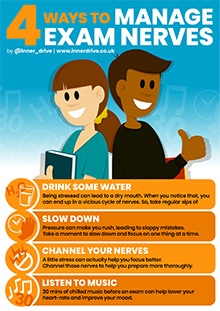
Exam nerves tip #2 – Drink some water
One of the side effects of being stressed is having a dry mouth. If this happens to nervous students in an exam, it can create a vicious cycle: being aware of their dry mouth makes them realise how stressed they are, making their mouth even drier. And it can also be incredibly uncomfortable and distracting.
In a collaborative study between the University of East London and the University of Westminster, researchers found strong evidence that the sensation of thirst could affect memory and attention, key tools needed for top exam performance. This is not a unique finding, which emphasises how drinking water can be a key performance booster.
Before exam season, try reminding students to buy a clear water bottle to take into the exam hall. A few small sips of water throughout their problem-solving may make all the difference in their results.
Exam nerves tip #3 – Nerves aren’t always bad
Many students think nerves are a sign that they’re unprepared and going to fail. But nerves can actually help you focus better. As the authors of this study on anxiety and performance state, “In certain situations, worry may enhance performance and facilitate concentration, because an individual who is worried about something may allocate extra mental resources that could enhance performance.” A simple way of seeing it is that nerves mean you care. If directed at the task at hand, people who care may concentrate more and try harder.
However, although a little stress can be a performance booster, we must also remember that too much anxiety can still be a bad thing. The Optimal Point theory states this perfectly, suggesting that there is an ‘optimal’ level of nerves. Too much or too little stress can lead to a student making poor decisions.
Try assuring students that a little bit of nerves before an exam isn’t necessarily a bad thing and that it may even enhance their performance. However, make sure they aren’t letting their anxiety spiral out of control either. If you need some tips on managing exam stress in students, check out our blog here.
Exam nerves tip #4 – Listen to music
Listening to chilled music is a good way to help manage exam nerves in the build-up to an exam (though not while revising). When listening to relaxing music, students’ heart rates can lower and their moods can improve dramatically.
The effectiveness of listening to music has been demonstrated through research. One study showed that music can not only reduce stress before exams but can also lead to better performance as a result. Another study showed that, for anxious individuals, listening to relaxing tunes can be as effective as a relaxing massage. This suggests that listening to some pleasant music before a test may go a long way in easing exam nerves.
Try encouraging students to make a pre-exam playlist. It may help them remain calm and focused instead of spiralling with anxiety. If they think it may be a helpful aid, remind them that relaxing tunes, such as instrumental or classical music, may be best.
Final thoughts on managing exam nerves
Exam nerves are completely normal, but they shouldn’t affect a performance so severely. Students may have all the knowledge they need to ace the exam, but stress before and during the test may unfairly impact their scores.
However, thanks to research, there are now lots of ways to control anxiety and remain calm. By teaching them the right techniques, we can help them approach exams with a clear mind and make sure they are achieving the grades that best reflect their ability.