

Students’ Sense of Belonging plays a crucial role in their school experience. It has consistently been linked to academic achievement, mental wellbeing and a range of other positive outcomes.
But what actually shapes a student’s Sense of Belonging?
Rather than viewing belonging as something that sits purely within the student, this blog will cover a framework model that shows how it is shaped by multiple, interacting layers of influence.
This framework offers a useful way for teachers and schools to better understand belonging, and importantly, to design interventions at multiple levels to help all students feel more included.
Read on to learn more about:
What is ‘School Belonging’?
A Sense of Belonging refers to the extent to which students feel accepted, valued, respected and included within their school community. It is not simply about being present in a classroom, but about feeling that you matter, that you are recognised as an important member of the school.
Importantly, belonging is not something that can be created through policy alone. While inclusive policies are important, students develop a Sense of Belonging through repeated interactions, shared norms and the messages they receive, both explicitly and implicitly, about who is valued in their school.
The Big Idea: A Socio-Ecological Model
Bronfenbrenner’s Ecological Systems Theory (1979) proposes that an individual’s development is shaped by a set of interconnected environmental systems, covering everything from immediate relationships to broader societal influences.
These five systems include:
- Individual – the student themselves
- Microsystem – immediate environment (e.g. family, school and peers)
- Mesosystem – interactions between microsystems (e.g. communication between parents and teachers, such as parents’ evening)
- Exosystem – indirect influences the child doesn’t directly experience (e.g. parental workplace stress, availability of community resources)
- Macrosystem – broader cultural context (e.g. societal values, norms, policies, and socioeconomic factors)
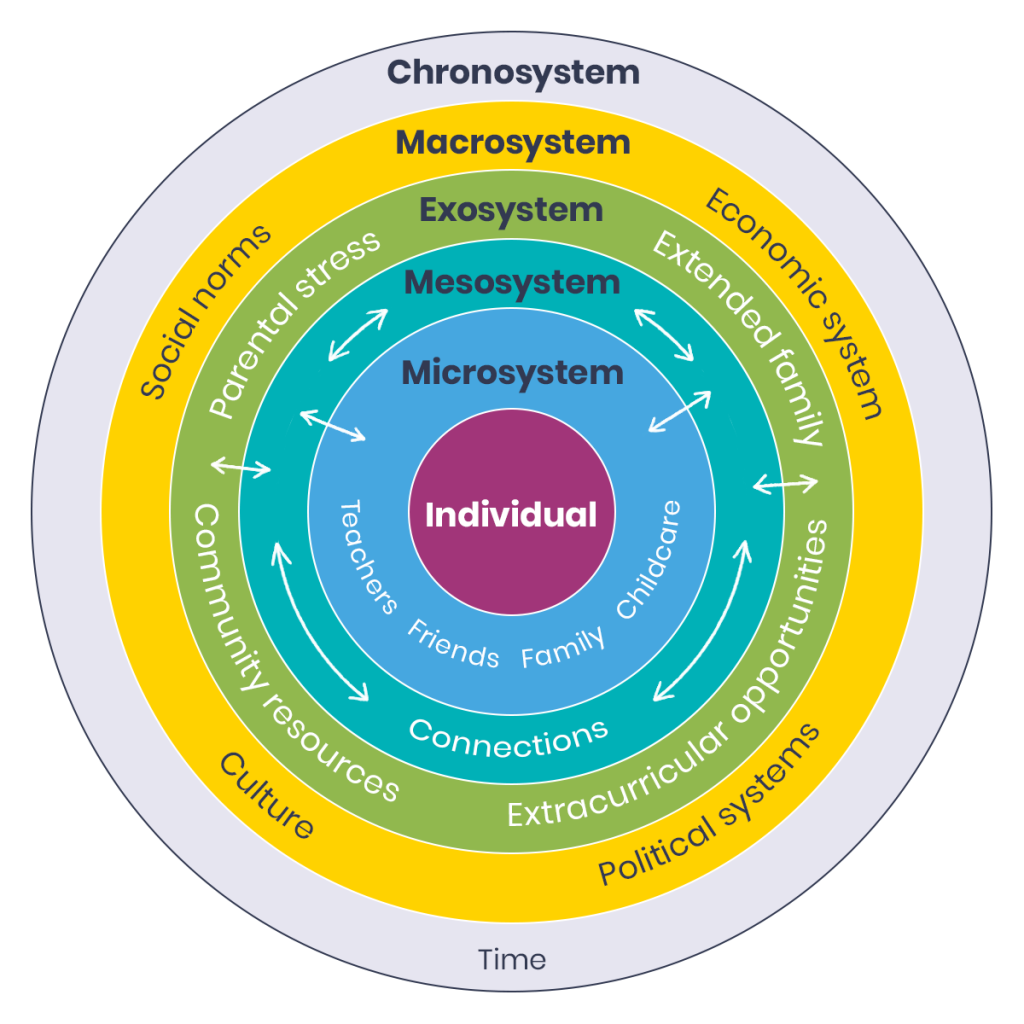
While this was originally proposed as a framework for understanding child development, recent research has applied it to school belonging. This shifts the focus away from seeing belonging as an individual trait, and instead positions it as the outcome of multiple, interacting systems within a student’s environment.
How each of Bronfenbrenner’s levels influences belonging
1. The Individual
At the centre of the model is the student. Characteristics such as motivation, self-esteem, emotional regulation and prior expectations all shape how Inclusion is experienced.
For example, students with higher self-efficacy may be more likely to engage in classroom activities, strengthening their Sense of Inclusion. Conversely, anxiety or low confidence can make forming connections harder.
Key takeaway: belonging doesn’t just come from traits; it also builds them. Feeling that they belong can create confidence.
2. The Microsystem: relationships matter most
The microsystem includes immediate relationships with teachers, peers and family. Positive teacher-student relationships are strongly linked to belonging. Feeling respected, supported and noticed helps students feel they “fit” within the school.
Peer relationships also play a key role: friends, acceptance and social inclusion all contribute.
Practical tips:
- Greet students, use names, check in regularly
- Combine warmth with high expectations
- Pay attention to classroom climate, as it can include or exclude students
3. The Mesosystem: connecting the dots
The mesosystem refers to interactions between the different parts of a student’s life, particularly home-school connections
When these systems are aligned, for example strong communication between parents and teachers, they provide coherent signals about a student’s place in school. Misalignment can create confusion or disconnect.
Practical tips:
- Maintain clear home-school communication
- Align expectations between school staff and families
- Provide opportunities for parents and guardians to engage with school
4. The Exosystem: indirect but influential
The exosystem covers influences the student may not directly experience, such as parental work stress, access to community resources and extracurricular opportunities.
These factors can indirectly affect a student’s connection to school. More opportunities for involvement can strengthen belonging, even if the student isn’t aware of the source.
Key idea: students are affected by systems they may never see.
5. The Macrosystem: the bigger picture
The macrosystem refers to the wider social, cultural and political context, including societal values, norms, policies and inequalities.
These shape what is prioritised in schools and who feels represented. For instance, a curriculum that lacks representation can make students struggle to see themselves reflected, affecting their Sense of Belonging.
Key idea: belonging is influenced by whether students feel seen by the system, not just by individuals.
Bringing it all together
Across all five levels, one thing becomes clear: belonging is not created in a single moment or by a single factor. It is the result of multiple systems working together.
A student may be confident (individual) but still feel excluded in a classroom with poor peer relationships (microsystem), or within a school where policies feel unfair (macrosystem).
The final takeaway: You can’t improve belonging by focusing on just one level; it requires a whole system approach.
Final Thoughts
Improving students’ Sense of Belonging requires us to move beyond seeing it as something students either have or lack. Instead, it is shaped by the environments, relationships and systems that surround them.
This means that every interaction, policy and classroom practice plays a role. While schools cannot control every level of influence, small consistent actions such as building strong relationships and creating inclusive environments can make a meaningful difference.
Ultimately, fostering belonging is not about a single intervention, but about developing a culture where every student feels seen, supported and valued.


