

In many classrooms, spelling is taught one concept at a time with lots of repetition, a process referred to as “blocked practice”. It feels efficient: one rule ticked off and then onto the next. However, you might later test pupils and realise that their ability doesn’t quite match their performance in class. They may struggle to apply spelling rules and confuse patterns that you thought they had nailed.
What if the way we organise practice, not just what we teach, determines how well children learn to spell?
The key to this might be Interleaving. This well-established principle involves pupils learning different concepts side by side, helping them spot the differences and similarities, and apply them more effectively later.
In this blog we will explore:
So, what are the most common pitfalls, and how can teachers avoid them? Read on to explore:
What is Interleaving?
Interleaving involves mixing up topics within the same subject when studying. This is the opposite of blocking, which is fully covering one topic before moving onto the next.
For example, blocked practice would look like learning 10 “-tion” words, followed by 10 “-sion” words. In contrast, interleaved practice would mix “-tion”, “-sion”, “-ss” and “-ie” words together.
The graphic below gives an example of the difference between both practice methods:

Although it can feel more challenging at first, Interleaving comes with several benefits:
- Improved academic performance
- Better long-term memory
- Greater understanding of when to use the correct rule
This is because it forces pupils to think about which rule to use, rather than simply applying the current one they are practising. It also strengthens their ability to distinguish between similar spelling patterns.
This is an example of a Desirable Difficulty, where learning feels harder in the moment but leads to stronger retention over time.
So, how can we use this to make spelling rule learning more efficient?
What the research says about Interleaving and spelling
In a recent study of German third-graders, researchers investigated the immediate and long-term effects of interleaved practice for learning spelling rules. They also explored whether instructional guidance, which are prompts and explanations that highlight key features and differences between concepts, enhanced the effectiveness of Interleaving by supporting comparison processes.
What did they do?
The study involved a pre-test, an intervention phase (where pupils either practised what they had learned using blocking or Interleaving), an immediate post-test and a follow-up test eight weeks later, to test long-term retention of the spelling rules.
What did they find?
The key findings from this research were that:
- Interleaving led to fewer spelling errors
- Interleaving led to better long-term retention (still evident 8 weeks later)
- It also improved transfer, helping pupils apply rules to new words
Importantly, the study also highlighted the role of instructional guidance. This involved giving pupils explicit prompts and explanations about why a spelling rule applies, rather than simply practising it.
The effectiveness of this guidance depended on pupils’ prior knowledge:
- Less confident learners benefited more from guidance during blocked practice, particularly in the early stages
- More confident learners benefited most from combining Interleaving with guidance, especially for long-term retention and transfer
Why does this happen?
Interleaving works because it forces pupils to think more carefully about their choices. Instead of repeatedly applying the same rule, they must decide which rule fits each word.
This strengthens their ability to distinguish between similar spelling patterns, which is called “discrimination learning”. In contrast, blocked practice can create a false sense of confidence, as pupils may perform well simply by repeating the same rule.
However, this also explains why blocked practice might be helpful earlier in learning. When pupils are first introduced to a new spelling rule, focusing on one pattern at a time reduces complexity and helps them build initial understanding.
As pupils become more confident, Interleaving becomes more effective. At this stage, mixing rules encourages deeper thinking and helps them learn not just how to apply a rule, but when to use it.
Interleaving also introduces a level of difficulty that, while challenging in the moment, leads to stronger learning over time. Instructional guidance supports this process by helping pupils focus on the key features that differentiate one rule from another.
What this means for the classroom
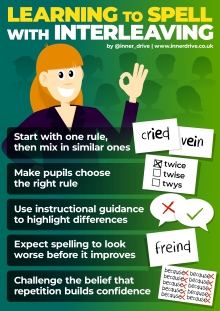
1. Start with one rule, then mix similar ones
When introducing a new spelling rule, it can be helpful to begin with blocked practice, so pupils understand the pattern.
However, once this foundation is in place, you can start to interleave similar spelling rules. For example:
- Mix “-tion” and “-sion” words in the same activity
- Combine “-ss” and “-c” patterns
- Alternate between “ie” and “ei” words
This helps pupils learn not just how a rule works, but when to use it.
2. Use spelling activities that require choice
Interleaving is most effective when pupils must actively decide which rule to apply. This can be built into tasks such as:
- Mixed spelling lists (rather than grouped by rule)
- Dictation exercises with varied patterns
- Multiple-choice spelling tasks where pupils justify their answer
The key is that pupils are not told which rule to use, they must identify it themselves.
3. Use instructional guidance to highlight differences
Simply mixing rules is not enough. Pupils benefit from guidance that draws attention to why a particular spelling is correct.
For example, teachers might ask:
- “What makes this a ‘-tion’ word rather than ‘-sion’?”
- “What sound or pattern are you looking for?”
This helps pupils focus on the features that distinguish similar spelling rules, strengthening their understanding.
4. Expect spelling to look worse before it improves
When pupils first encounter interleaved spelling practice, they may:
- Make more mistakes
- Feel less confident
- Prefer blocked practice
This is normal. Interleaving increases difficulty in the short term, but this is what drives better long-term learning. Making this explicit to pupils can help them stay motivated.
5. Address misconceptions about spelling practice
Pupils may believe that repeating the same spelling pattern is the most effective way to learn. However, this can create a false sense of confidence.
By showing pupils how Interleaving improves their ability to apply rules in new contexts, teachers can help them develop a more accurate understanding of how learning works.
Final thoughts on Interleaving for learning spelling
Interleaving challenges a common assumption about learning: that easier practice leads to better results. While blocked practice can feel effective in the moment, it does not always prepare pupils to apply their knowledge independently.
By combining Interleaving with the right level of instructional guidance, teachers can help pupils move beyond simply learning spelling rules to understanding how and when to use them.


