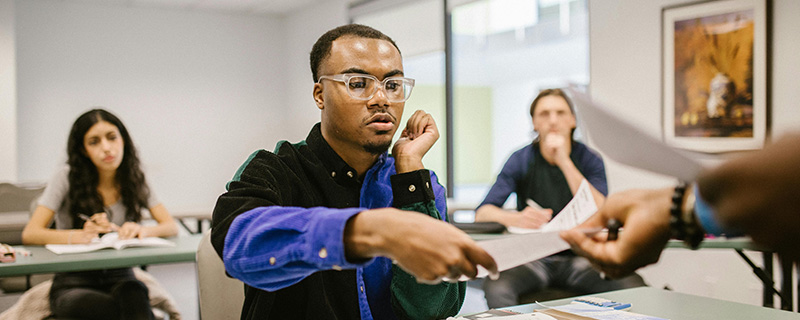
Think, Pair, Share is a classroom-favourite strategy to promote collaborative learning. In theory, it’s a simple strategy: pose a question, give students time to think, get them talking in pairs, and then invite them to share with the class.
But in practice, things may not always run so smoothly. This well-meaning strategy can often result in “Think, Pair, Stare” instead. This is characterised by students freezing and hoping they won’t get asked to share their thoughts with the wider group when asked to. This can be particularly true for shy students.
So, how do we make sure we avoid ‘Think, Pair, Stare’ and end up with a truly great ‘Think, Pair, Share’?
In this blog, we’ll explore:
- A quick recap on what Think, Pair, Share is
- Why it can be uniquely challenging for shy students
- Practical ways to support these students in the classroom
What is Think, Pair, Share?
Think, Pair, Share is a powerful teaching technique that encourages students to engage with a question. It breaks down classroom-wide discussion into three manageable steps:
- Think – Each student takes a moment to reflect on a question independently. This activates prior knowledge and allows for Retrieval Practice, strengthening memory and understanding.
- Pair – Students then turn to a partner to discuss their thoughts. This stage provides a valuable opportunity to compare interpretations, clarify ideas and hear different perspectives.
- Share – Finally, pairs share their ideas with the whole class. By this point, students should feel more confident, having validated and extended their thinking during the pair discussion.
Used well, this technique can be transformative, helping students process ideas deeply and support Oracy. But what about those who struggle to share in the first place?
The shy student’s perspective
For shy students, participation is not only about knowing the right answer; it’s about managing the emotional risk of possibly being judged. While they often do have great ideas, the thought of sharing them out loud can feel overwhelming.
Left unaddressed, this discomfort can limit a student’s engagement and may lead to them withdrawing entirely during the sharing phase, relying on their more confident partner to speak up. The consequences can extend beyond reduced classroom involvement: research has shown that shyness is linked to lower academic performance, increased feelings of loneliness and a heightened risk of anxiety.
Importantly, shyness isn’t one-size-fits-all. For some students, it may stem from ongoing social anxiety; for others, it might be a temporary phase. That’s why sensitivity matters. It’s important to be attuned to these individual differences and support students thoughtfully, rather than assuming disengagement means disinterest.
This is why it’s not enough to simply implement Think, Pair, Share. Instead, try to incorporate it into your classroom with intention. A truly inclusive version of the strategy doesn’t just invite students to speak; it helps them feel secure enough to want to speak. So, how do we do this?
Helping shy students to speak up
Thankfully, small changes can make a big difference. Here are four research-backed strategies to make Think, Pair, Share more inclusive for those who need the most encouragement.
1. Create psychologically safe classrooms
Psychological safety is the foundation of participation. Students need to feel like the classroom is a space where mistakes are part of learning, not something to be embarrassed about.
So, show students that it’s safe to be uncertain. This can be done when modelling an answer by thinking aloud, showing uncertainty, and letting students see that learning isn’t about having all the answers.
Strong student-teacher relationships matter as well. A warm greeting at the door, remembering students’ interests, or quietly acknowledging their efforts can gradually build trust. Over time, these small moments lay the groundwork for students to take academic risks like participating in discussions.
2. Reduce fear of negative evaluation
One of the biggest barriers for shy students is the fear of being judged, especially in front of their peers. That’s why it’s crucial to shift the classroom focus from performance to growth. This starts with feedback. By giving effective feedback that focuses on the process rather than just the outcome, you reinforce the idea that effort leads to progress.
3. Set clear, high expectations for everyone
It can be tempting to “let shy students off the hook” when it comes to participation. When we silently excuse them from contributing, we may unintentionally send the message that their voice doesn’t matter.
Instead, communicate that everyone is expected to participate in some way. Communicate that participation is a skill that can be learned and strengthened over time.
To help with this, support students with gentle scaffolds. This can be done by offering sentence starters or a heads-up that they’ll be sharing or by helping them set small, personal goals for participation and celebrating when they achieve them.
4. Cold-Calling in a Warm Environment
Cold-Calling, when done right, can be a powerful tool for encouraging shy students. The key is to make Cold-Calling predictable, supportive, and gradual.
Let students know ahead of time that you’ll be inviting different people to share, setting the expectation that Cold-Calling will happen. Over time, this practice becomes normalised. Students no longer feel singled out but expected and prepared to participate instead.
Final thoughts
Supporting shy students takes intentionality and recognising that participation is both a skill and an emotional leap. When we build the structures to make this leap possible, we don’t just fix “Think, Pair, Stare” – we make classrooms where participation feels safe and every student feels like they belong.